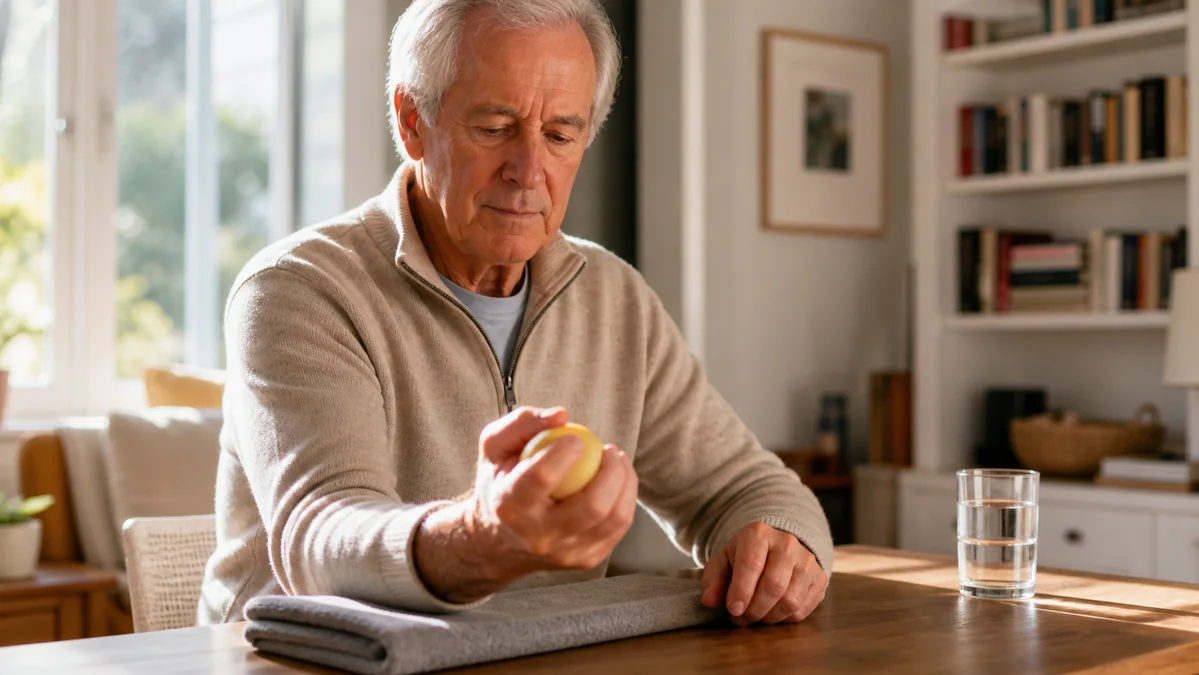
Grip strength shows up everywhere: carrying groceries, opening jars, holding a phone, using a cane, or feeling steady with a railing. The goal of a simple routine is not to \"train like an athlete.\" It's to make daily tasks feel more secure.
Quick answer: Do a brief routine that includes gentle squeezing, finger opening, and a light carry. Health sources for older adults commonly recommend including strength activities as part of overall fitness, alongside balance and endurance.
This is general fitness information, not medical advice. If you have severe hand pain, numbness, recent injury, or a condition like severe arthritis, ask a clinician or therapist for individualized guidance.

The two rules that keep this routine safe
- Gentle effort beats maximal effort. You should feel working muscles, not sharp pain.
- Train opening as well as squeezing. Constant squeezing alone can make hands feel tight.
If anything causes tingling, sharp pain, or swelling that lasts into the next day, reduce intensity and consider professional input.
What you need (choose one)
Pick the simplest option you already have:
- A rolled hand towel
- A soft stress ball
- A pair of rubber bands (light)
Optional: a light tote bag for carries (start with something very light, like a small water bottle).
The 5-minute grip routine
Do the routine 3-5 days per week. If you like daily habits, keep it very gentle on \"in-between\" days.
Use this order so both gripping and opening muscles get attention:
- Complete 10 gentle towel squeezes per hand.
- Open and close each hand 10-15 times.
- Perform 8-10 light pinches per side.
- Carry a very light object for 20-30 seconds per hand.
- Finish with comfortable wrist motion for 30-60 seconds.
1) Towel squeeze (60 seconds)
- Roll a towel into a tube.
- Squeeze for 3 seconds, then relax for 3 seconds.
- Repeat 10 times per hand.
Keep the wrist neutral (not bent sharply).
2) Finger open-and-close (60 seconds)
This balances the squeeze work:
- Make a gentle fist, then open the hand wide.
- Move slowly and keep shoulders relaxed.
- Repeat 10-15 times per hand.
If you use rubber bands, place one around fingers and open gently for light resistance.
3) Pinch practice (60 seconds)
Use a towel corner or soft object:
- Pinch and hold for 2 seconds, then release.
- Repeat 8-10 times per side.
Keep effort light. Pinch is easy to overdo.
4) Light carry (60-90 seconds)
Carry something light in one hand (a small bag) and walk slowly around the room for 20-30 seconds, then switch hands.
Focus on posture: tall spine, shoulders down, steady steps.
Internal link: if you're also rebuilding whole-body steadiness, see Easy strength activities for older adults.
5) Gentle wrist range (30-60 seconds)
Finish with easy motion:
- Slow wrist circles (small range)
- Open/close the hand a few times
Stop if this causes pain.
How to progress (without guessing)
Progress is simple:
- Week 1: do the routine with very light effort.
- Week 2: add one extra repetition per move (or add one extra day per week).
- Week 3: slightly increase squeeze time (3 seconds -> 4 seconds), not intensity.
Older-adult exercise guidance generally emphasizes consistency and combining different activity types over \"all-or-nothing\" workouts.
Quick wins for daily tasks
If jars are the main struggle:
- Use a rubber grip pad (better traction beats brute force).
- Try opening when hands are warm (after a warm wash).
- Use two-hand strategies rather than straining one wrist.
If carrying bags is the main struggle:
- Use smaller loads.
- Carry closer to the body.
- Consider a cross-body bag or rolling cart on heavy days.
Internal link: if you use a cane or are considering one, see How to fit a cane or walking stick.
Pair grip work with steadier balance (optional)
Grip strength helps, but it works best when your whole body feels stable. If you have time, add one small balance habit after the routine:
- Stand tall and shift weight side-to-side for 30 seconds while holding a counter.
- Do 5 slow sit-to-stands from a stable chair.
Keep it easy and controlled. The goal is confidence, not fatigue.
Check the hands before each session
Skip squeezing when a finger or wrist is newly swollen, hot, sharply painful, numb, or recently injured. Remove rings before exercise if the hands tend to swell. Keep the forearm supported and the wrist straight rather than bent toward the little finger. Complete 1 set on each side and compare comfort, not maximum force. Persistent loss of grip, dropping objects, night numbness, or pain that interferes with daily tasks deserves assessment by a clinician or hand therapist.